

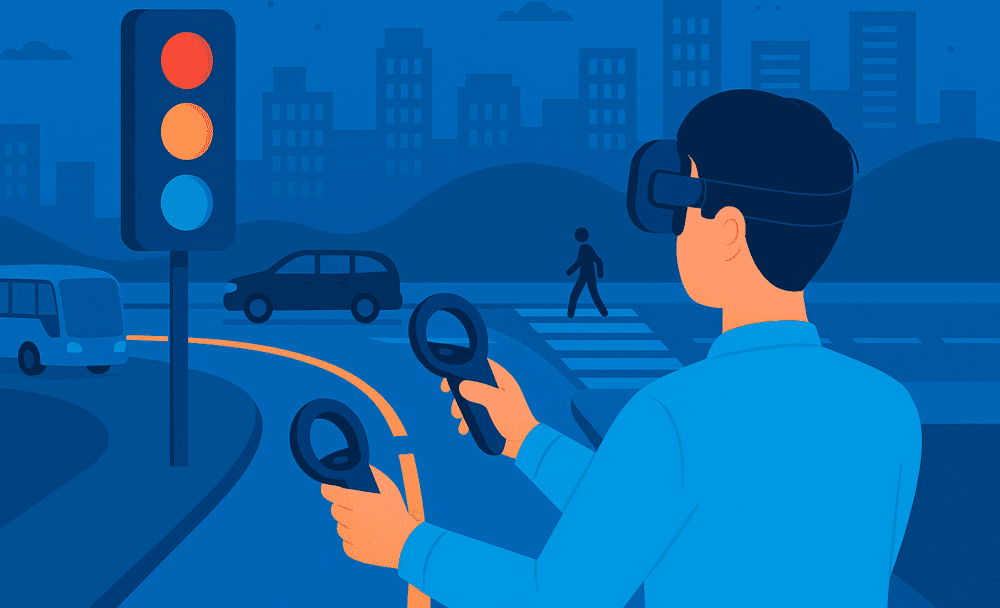
Traffic systems today are more dynamic, complex, and tech-driven than ever before. For students stepping into the world of transportation engineering, learning from static diagrams and traditional lectures is no longer enough. To truly grasp the functioning of real-world traffic environments, immersive experiences are becoming a necessity, not a luxury.
That’s where VR for transportation and traffic training comes into the picture.
The Challenge in Transportation Education
Universities offering transportation engineering programs face a growing need to keep their students ready for modern-day infrastructure challenges. But the gap between theoretical knowledge and practical application is often too wide.
Some of the challenges include:
1. Limited access to real-world traffic systems.
2. Safety concerns in live demonstrations.
3. Lack of practical tools to understand systems like signal coordination, pedestrian safety, or autonomous vehicle behavior.
Traditional labs can’t simulate rush hour congestion or emergency rerouting scenarios but traffic management simulation in VR can.
What Is VR for Transportation and Traffic Training?
VR for transportation and traffic training is an immersive learning method where students can enter a fully interactive virtual environment to simulate real-world traffic conditions. Whether it’s managing a multi-lane intersection or analyzing public transportation logistics, VR brings life to textbook concepts.
Examples of VR Simulations for Transportation:
| Simulation Type | Real-World Scenario Trained |
|---|---|
| Signal Timing Coordination | Urban traffic management |
| Pedestrian-Vehicle Interaction | Safety design in busy zones |
| Highway Traffic Flow Analysis | Congestion detection |
| Public Transport Route Planning | Efficiency optimization |
These simulations allow students to learn in real time, fail safely, and experiment with new systems—all without stepping out of the classroom.
Benefits of Traffic Management Simulation in VR
1. Real-Time Interaction
Students can interact with virtual signals, vehicles, and road users. They can modify variables—like vehicle flow, light cycles, or crosswalk timings—and instantly see the effects.
2. Risk-Free Learning Environment
No traffic incident or costly consequence from a wrong move. A mistake becomes a lesson.
3. Scalable Practice
Whether you're teaching 20 students or 200, VR labs make it easy to scale learning without resource limitations.
4. Improved Retention
According to PwC, VR learners complete training 4x faster and retain content 275% more than traditional learners.
5. Industry-Relevant Skills
Students gain exposure to tools and scenarios they will likely encounter in government transport bodies, private infrastructure firms, or smart city projects.
Inside a Transportation Engineering Virtual Lab
A transportation engineering virtual lab replicates road networks, junctions, signals, and public transportation systems through interactive 3D environments. Students can simulate and observe everything, from traffic jams to sensor-based smart lights.
Key Features:
1. Autonomous vehicle behavior modeling
2. Emergency traffic routing
3. Intersection design testing
4. Signal phase & timing optimization
5. Pedestrian flow modeling
With VR headsets or desktop streaming, this lab becomes accessible to every student, regardless of their physical location.
How iXR Labs is Pushing the Boundaries
At iXR Labs, we develop VR modules for engineering colleges that mirror real-world infrastructure intricacies. Our simulations cover not just the basics of road design, but also advanced systems like adaptive traffic control and mobility-as-a-service (MaaS) planning.
We work closely with academic institutions to align modules with curriculum goals and ensure high engagement through interactivity and gamified assessments.
Instructors can use a dashboard to track performance, provide feedback, and run assessments based on simulation outcomes.
_34407.jpg "Nels Madsen")
VR Training for Transportation Students: What to Expect
Here’s what transportation students can gain from VR-based training:
1. Hands-on Exposure: Train in real-world scenarios like signal design, crash site analysis, and logistics optimization.
2. Analytical Thinking: Adjust different variables and instantly see their impact on traffic flow.
3. Decision-Making Practice: Choose between multiple traffic policies and test their effectiveness.
4. Collaborative Learning: Work in teams to solve transportation challenges in a shared virtual space.
This level of immersive learning for traffic systems helps students develop not only technical know-how but also soft skills like problem-solving and strategic thinking.
Why Universities Are Adopting Traffic Control Simulation in VR
Universities that implement traffic control simulation are witnessing measurable benefits:
“Our students not only understand traffic systems better, but they’re also more confident in proposing real-world solutions during internships.”
— Transportation Faculty Member, IIT Delhi
Several institutions are integrating VR for higher education to ensure that their engineering departments stay ahead in pedagogy and performance.
These tools also aid in accreditation, as VR-based programs show clear evidence of learning outcomes and practical proficiency.
Real-World Use Cases from Campuses
A university in South India used iXR’s VR modules to train 200+ transportation engineering students in multi-intersection traffic optimization.
Students at a European technical university worked on a simulated smart-city traffic grid to understand IoT-based traffic lights.
One engineering college in the UAE reduced simulation costs by 70% by switching from hardware-heavy labs to VR-based modules.
These examples show how VR training for transportation students isn't just a teaching tool—it’s a strategic asset.
How VR Improves Civil Engineering Drawings and Designs
With integrated visual simulation, students can also understand how transportation infrastructure ties into urban planning and construction layouts. VR overlays help them visualize road gradients, traffic islands, turning radii, and drainage alignment directly over city maps.
This directly complements efforts to VR improve civil engineering drawings, making spatial planning much more intuitive and error-free.
Combined with VR for civil engineering, these modules bring interdisciplinary clarity to learners in both construction and transportation domains.
How to Get Started with VR Transportation Labs
Setting up VR labs for transportation doesn’t require massive overhauls. At iXR Labs, our team helps universities implement virtual modules that:
1. Fit into the existing curriculum
2. Run on browser-based systems or headsets
3. Include performance dashboards
4. Offer multilingual support for accessibility
All that’s needed is basic hardware and a vision to modernize your learning environments.
Final Thoughts: The Future of Transportation Education is Virtual
As the transportation industry moves towards AI-driven systems, smart roads, and automated mobility, the gap between industry expectations and academic training must close fast.
Using VR for transportation and traffic training, universities can ensure that their graduates don’t just understand what’s on paper, but can make decisions, test assumptions, and solve real-world traffic problems.
And in this changing world, those are the graduates who’ll lead the way.
Want to explore how iXR Labs can bring these simulations to your classrooms? Visit ixrlabs.com or request a demo today.
.jpg)