
In the competitive landscape of higher education, universities and colleges are under constant pressure to meet global benchmarks. Accreditation frameworks such as NAAC (National Assessment and Accreditation Council), NIRF (National Institutional Ranking Framework), and ABET (Accreditation Board for Engineering and Technology) measure the overall quality of education, infrastructure, teaching, learning outcomes, and innovation. For institutions striving to rise in these rankings, adopting immersive technologies like VR labs is no longer just an option—it’s becoming a strategic necessity.
This article explores how VR labs for NAAC NIRF ABET accreditation can directly impact evaluation parameters, enhance student outcomes, and ultimately strengthen an institution’s credibility and global standing.
Why Accreditation Scores Matter
Accreditation scores and rankings are not just about recognition; they influence:
• Student admissions: High scores attract quality students.
• Faculty recruitment: Better scores help institutions bring in skilled educators.
• Funding opportunities: Governments and private bodies prefer funding institutions with strong accreditation.
• Global visibility: Higher NIRF and ABET rankings improve international partnerships.
In such a competitive academic climate, even incremental improvements in accreditation can make a huge difference. This is where virtual reality labs for higher education step in as game changers.
Role of VR Labs in NAAC, NIRF, and ABET Evaluations
1. Enhancing Teaching-Learning Methodologies
One of the strongest evaluation metrics in NAAC and ABET revolves around innovative pedagogy. Traditional classroom teaching often fails to provide hands-on experience, especially in engineering, medicine, and applied sciences.
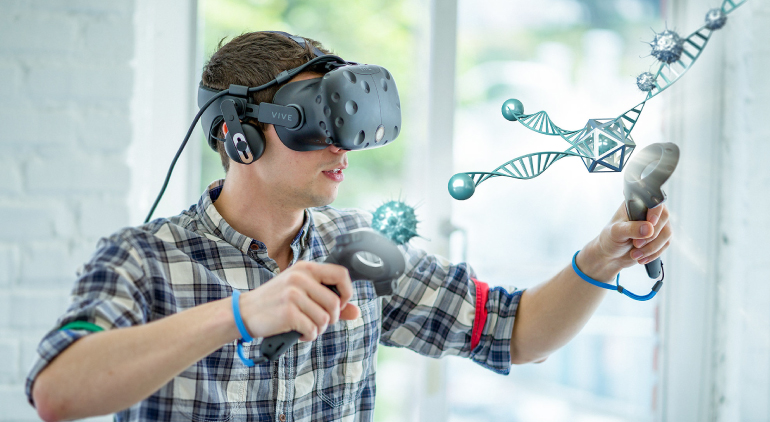
By setting up VR labs, institutions can create simulated real-world environments where students learn through practice rather than rote memorization. Whether it’s a virtual physics lab, a mechanical workshop, or a medical training simulation, these labs boost experiential learning outcomes.
2. Improving Research and Innovation Metrics
NIRF scores give significant weightage to research productivity and innovation. VR labs provide students and faculty with cutting-edge tools to experiment with ideas that are otherwise resource-intensive or unsafe in real life.
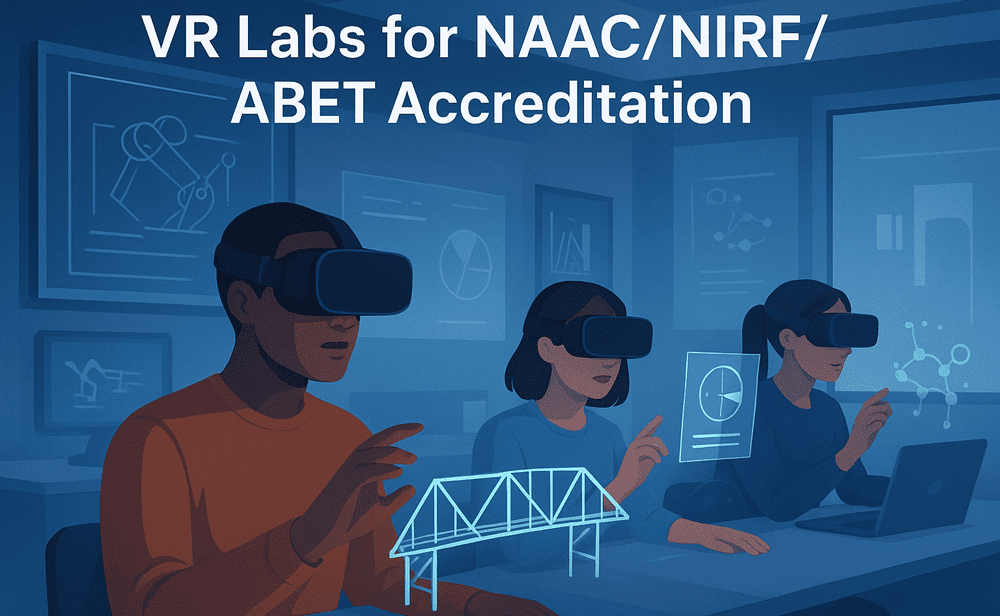
For instance, engineering students can test bridge designs under different load conditions, while medical students can simulate complex surgeries. These innovative use cases directly add value to an institution’s research output.
3. Strengthening Industry Readiness of Students
ABET focuses heavily on student readiness for real-world challenges. Virtual labs allow students to practice industry-grade scenarios safely, repeatedly, and cost-effectively.
For example:
• Civil engineers can explore VR for traffic training simulations to study urban mobility.
• Electrical engineers can benefit from VR for electrical training modules.
• Physics and science students can conduct experiments using virtual physics labs without worrying about infrastructure constraints.
By offering such practice-based training, colleges prove their commitment to bridging the industry-academia gap.
4. Boosting Infrastructure Scores
A major chunk of NAAC and NIRF evaluation criteria assess the quality of infrastructure. While constructing new labs or research centers requires huge capital, investing in immersive tech in class through VR labs is far more cost-effective.
A VR-enabled setup provides access to multiple virtual laboratories without the need for physical expansion. This not only saves space and cost but also reflects positively in accreditation reports.
5. Increasing Student Satisfaction
Student feedback is a direct metric for NAAC and NIRF. When learners experience engaging, interactive, and risk-free training through VR labs, their satisfaction levels soar. High satisfaction translates into positive survey results, strengthening institutional rankings.
VR Labs and NAAC Accreditation
NAAC assesses institutions across seven criteria, including Curricular Aspects, Teaching-Learning and Evaluation, and Research, Innovation, and Extension. VR labs directly contribute to:
• Curricular Aspects: Enabling integration of experiential modules.
• Teaching-Learning: Promoting active and collaborative learning.
• Innovation: Encouraging patentable ideas and research projects.
Moreover, NAAC rewards institutions that adopt technology-enabled learning solutions—making VR in education a strong contributor to higher scores.
VR Labs and NIRF Rankings
NIRF rankings rely heavily on five parameters: Teaching, Learning & Resources, Research and Professional Practices, Graduation Outcomes, Outreach and Inclusivity, and Perception.
• Teaching and Learning: Students learn faster through interactive VR simulations.
• Research Practices: Faculty can publish innovative VR-based research.
• Graduation Outcomes: Better-trained students secure higher employability.
• Inclusivity: VR labs can bring equity by giving the same learning experience to all students, regardless of background.
Institutions adopting VR labs gain an edge in NIRF assessments, as they can demonstrate tangible innovation and measurable outcomes.
VR Labs and ABET Accreditation
ABET’s focus is global, emphasizing the quality of programs in engineering and technology. VR labs help institutions meet ABET’s student outcomes criteria, which include:
• Problem-solving abilities: Students simulate complex challenges.
• Experimentation and analysis: VR allows safe and accurate testing of ideas.
• Communication skills: Students collaborate in VR projects.
• Ethics and global impact: Simulations demonstrate real-world consequences of engineering decisions.
By integrating VR labs for ABET accreditation, institutions can clearly show that graduates are well-prepared for international industry standards.
Internal Challenges Institutions Face
Despite the clear benefits, institutions face hurdles such as:
• Funding constraints for advanced technology adoption.
• Lack of skilled faculty to operate VR systems.
• Resistance to moving away from traditional teaching.
Thankfully, solutions exist. Institutions can fund VR labs through grants, CSR projects, or public-private partnerships. Training faculty is also easier now with accessible platforms and service providers.
Beyond Accreditation: Long-Term Benefits
While NAAC, NIRF, and ABET scores are immediate motivators, VR labs also bring broader long-term benefits:
• Attracting international students who seek modern pedagogy.
• Supporting lifelong learning by enabling professionals to upskill on campus.
• Building stronger industry partnerships as VR-trained graduates are more job-ready.
Creating a reputation for innovation, which supports overall institutional growth.
Getting Started with VR Labs
Many institutions wonder where to begin. The best approach is to start small:
• Introduce VR for electrical or virtual physics labs as pilot projects.
• Gradually expand to cover multi-disciplinary programs.
• Integrate with AI for smart assessment and feedback.
For institutions with ambitious goals, partnering with a virtual reality development company ensures tailored solutions aligned with accreditation criteria.
Conclusion: VR Labs as Catalysts for Accreditation Success
The path to higher NAAC, NIRF, and ABET scores is not just about ticking boxes—it’s about genuinely transforming education. By adopting VR labs for NAAC NIRF ABET accreditation, institutions can:
• Enhance teaching-learning quality
• Improve research productivity
• Strengthen graduate employability
• Maximize infrastructure efficiency
• Boost student satisfaction
As universities compete globally, the early adopters of VR technology will not just achieve better scores but will also set new benchmarks in education. For institutions looking to improve their academic standing, the question isn’t “Can VR labs help?”—it’s “How soon can we implement them?”